Per gli amanti dell’arte e della storia, Narni offre l’interessante possibilità di visitare un gran numero di ambienti sotterranei nell’ambito di una visita guidata molto ben strutturata alla Narni Sotterranea.
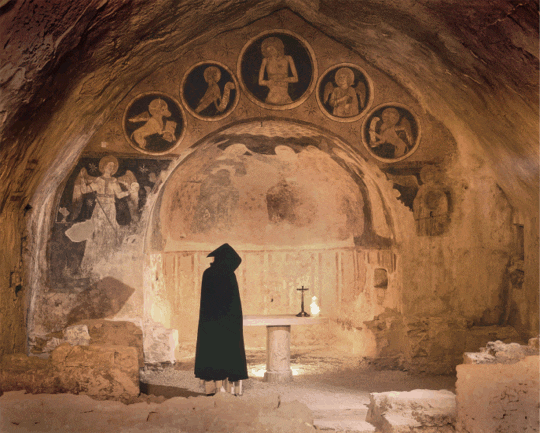
La visita si articola nei locali sotterranei dell’antico complesso del Convento di San Domenico, a partire dall’antica chiesa protoromanica affrescata nel XIII e nel XV secolo, che fu scoperta solo nel 1979 da un gruppo di giovani speleologi grazie ai quali fu possibile riportare alla luce tutto il complesso di Narni Sotterranea.
Tra gli altri locali, è possibile ammirare i resti di un impianto romano con cisterna, l’acquedotto romano con annesso Lacus, una cella ricca di graffiti fatti dai reclusi dal Tribunale dell’Inquisizione.
![]()
>>Vuoi visitare Narni Sotterranea? Consulta ora le offerte dei migliori hotel nelle vicinanze di Narni
Cosa Vedere a Narni Sotterranea: arte e idraulica
La visita guidata ha inizia dal Convento di San Domenico, entrando nell’annessa chiesa che conserva alcuni tra gli affreschi più antichi della città. Gli scavi avvenuti in questo ambiente hanno scoperto degli importanti ritrovamenti archeologici, che sono stati valorizzati dai successivi lavori di recupero e dall’istallazione di un pavimento vetrato che permette di ammirarli al meglio. Una ricostruzione virtuale accompagna il visitatore raccontando le varie fasi storiche che hanno caratterizzato l’antica chiesa, costruita sui resti di un tempio romano.
Passando poi per un varco della muratura, si prosegue la visita in un locale che ospitò probabilmente una domus romana di cui oggi rimane l’antica cisterna. Seguono allora i sotterranei dell’acquedotto romano della “Formina”: grazie a una particolare istallazione, il visitatore potrà entrare virtualmente nei cunicoli dell’acquedotto romano. Il percorso attraversa i Trafori di San Biagio, San Silvestro e del Monte Ippolito.
La visita completa al percorso sotterraneo dell’acquedotto si effettua a parte grazie all’associazione Subterranea. Il percorso si snoda per 700 metri attraverso l’unico acquedotto romano aperto al pubblico in Italia, terminando con una ripida scala a chiocciola scavata nella roccia che permette di uscire da un pozzo profondo circa 18 metri. La visita ha una durata totale di circa 2 ore e mezza – 3 ore e si effettua unicamente da maggio a ottobre nei giorni festivi e prefestivi su prenotazione, con gruppi di minimo 4-5 persone e massimo 6-8 persone.
Inoltre, sotto Piazza Garibaldi, è situata infine una grande cisterna altomedievale detta Lacus, con volte in pietra concia e resti del pavimento in opus spicatum. Al suo interno è attualmente in fase di allestimento un percorso didattico sull’importanza dell’acqua per la vita sulla Terra.
![]()
Cosa Vedere a Narni Sotterranea: storia e misteri
La visita prosegue percorrendo un lungo corridoio che si apre in una grande sala, sede degli interrogatori del Tribunale ecclesiastico durante l’Inquisizione. Gli studiosi hanno collegato questo luogo con la cosiddetta “stanza dei tormenti”, di cui si fa menzione in importanti documenti conservati negli Archivi Vaticani e nel Trinity College di Dublino. Grazie a queste carte, si è potuta ricostruire la storia dell’Inquisizione a Narni, la cui sede fu attiva a metà del XIX secolo.
Di questo ambiente fa parte anche una piccola cella assolutamente unica, sulle cui pareti è possibile ammirare segni e graffiti lasciati dai prigionieri del Tribunale, toccante testimonianza delle sofferenze vissute dagli inquisiti. Non avendo nient’altro a disposizione, infatti, i prigionieri utilizzarono dei cocci appuntiti per lasciare segni, nomi, date e simboli graffiando l’intonaco bianco.
Di particolare rilevanza sono i messaggi lasciati da Giuseppe Andrea Lombardini, prigioniero che trascorse nella cella circa 90 giorni tra il 1759 e il 1760. Egli incise parole e simboli in un linguaggio fatto di segni massonici e alchemici, secondo un suo preciso disegno mentale, allo scopo di evitare che il messaggio fosse compreso e cancellato dagli inquisitori. Leggenda vuole che il suo fantasma aleggi ancora nella cella e nei sotterranei.
![]()
Visitare Narni Sotterranea
La visita a Narni Sotterranea è guidata e ha una durata di circa 1 ora – 1 ora e mezza, a seconda anche del numero dei partecipanti. Le visite guidate si effettuano in italiano ma sono a disposizione delle audioguide in inglese, francese e tedesco comprese nel prezzo del biglietto. Le visite seguono il seguente calendario di orari:
01 NOVEMBRE – 31 MARZO
Sabato: una visita alle ore 15.00
Domenica e festivi: visite alle ore 11.00, 12.15, 15.00 e 16.15 (escluso il giorno di Natale)
01 APRILE – 14 GIUGNO
Sabato: visite alle ore 12.00, 15.00, 16.15 e 17.30
Domenica e festivi: visite alle ore 10.00, 11.15, 12.30, 15.00, 16.15 e 17.30
15 GIUGNO – 15 SETTEMBRE
Dal Lunedì al Venerdì: una visita alle ore 12.00 e una alle ore 16.00.
Sabato: visite alle ore 12.00, 15.00, 16.15 e 17.30
Domenica e festivi: visite alle ore 10.00, 11.15, 12.30, 15.00, 16.15 e 17.30
16 SETTEMBRE – 31 OTTOBRE
Sabato: visita alle ore 12.00, 15.00, 16.15 e 17.30
Domenica e festivi: visite alle ore 10.00, 11.15, 12.30, 15.00, 16.15 e 17.30
Il prezzo del biglietto è di € 6,00. Sono previste riduzioni a € 5,00 per gruppi oltre le 20 persone, a € 3,00 per ragazzi dai 6 ai 14 anni e a € 3,00 per studenti. I bambini sotto i 6 anni entrano gratuitamente.
Per coppie o per gruppi al di sotto delle 10 persone non è necessaria la prenotazione. Vi basterà presentarvi circa 10 minuti prima dell’orario indicato per la visita. Per i gruppi al di sopra delle 10 persone la prenotazione è invece obbligatoria; inoltre, questi gruppi possono concordare e prenotare una visita guidata in qualsiasi giorno e orario.
![]()
Buona visita a Narni Sotterranea!
For lovers of art, history, and mystery, Narni offers the fascinating opportunity to explore a series of remarkable underground spaces through a guided tour of Narni Underground.
Not your usual tour, but a true journey back in time, discovering the secrets of the ancient Dominican convent of Santa Maria Maggiore. The visit begins with the proto-Romanesque church dedicated to St. Michael, frescoed between the 13th and 14th centuries. This church was discovered only in 1979 by a group of young speleologists, thanks to whom the entire underground complex was brought back to light.
Through interactive systems, visitors can learn about the Roman aqueduct of ancient Narnia, explore a cell filled with graffiti left by prisoners of the Inquisition Tribunal, discover a Byzantine mosaic, and much more.
![]() Want to visit Narni Underground? Check out the best hotel deals near Narni now.
Want to visit Narni Underground? Check out the best hotel deals near Narni now.
What to See at Narni Underground: Art and Hydraulics
The guided tour begins in the underground rooms of the Convent of Santa Maria Maggiore, entering the adjoining church, which preserves some of the oldest frescoes in the city. Excavations carried out here uncovered important archaeological finds, later enhanced through restoration work and the installation of a glass floor that allows visitors to admire them at their best. A virtual reconstruction accompanies visitors, illustrating the various historical phases that shaped the site.
Through an opening in the wall, the tour continues into a room where an ancient cistern testifies to the former presence of a Roman domus. Thanks to a special installation, visitors can virtually enter the tunnels of the Roman “Formina” aqueduct that once supplied the city.
There are limited-time offers for farm stays in the Narni area! Click and check them out now.![]()
What to See at Narni Underground: History and Mysteries
The visit continues along a long corridor that opens into a large hall, once used for interrogations by the ecclesiastical tribunal during the Inquisition. Scholars have linked this site to the so-called “torture chamber,” mentioned in important documents preserved in the Vatican Archives and at Trinity College in Dublin. These records have made it possible to reconstruct the history of the Inquisition in Narni, whose headquarters remained active until the mid-19th century.
Part of this area includes a truly unique small cell, whose walls still bear marks and graffiti left by prisoners of the Tribunal—a moving testimony to the suffering endured by those accused. With nothing else at their disposal, prisoners used sharp shards to scratch names, dates, symbols, and signs into the white plaster.
Of particular significance are the messages left by Giuseppe Andrea Lombardini, a prisoner who spent about 90 days in the cell between 1759 and 1760. He carved words and symbols in a language composed of Masonic and alchemical signs, following a precise mental design, in order to prevent the message from being understood and erased by the inquisitors. Legend has it that his ghost still lingers in the cell and the underground passages.
![]() Book your visit now with BellaUmbria!
Book your visit now with BellaUmbria!
Visiting Narni Underground (Advance booking required by calling +39 339 1041645 from 9:00 am to 6:00 pm)
The visit to Narni Underground is guided and lasts approximately 75–90 minutes. Tours are conducted in Italian, but audio guides in English, French, and German are included in the ticket price. Tours in other languages can be arranged upon request.
Opening Hours
October 1 – March 31
Saturday and public holidays (excluding Christmas): from 11:00 am to 4:00 pm, every 30 minutes.
April 1 – June 15
Saturday: from 11:00 am to 5:30 pm, every 30 minutes.
Sunday and public holidays: from 10:00 am to 5:30 pm, every 30 minutes.
June 16 – September 30
Monday to Friday: tours at 11:00 am – 11:30 am – 12:00 pm – 3:00 pm – 3:30 pm – 4:00 pm.
Saturday and public holidays: from 10:00 am to 5:30 pm, every 30 minutes.
Ticket Prices
Full ticket: €8.00
Groups of more than 20 people: €7.00
Children aged 6 to 11: €5.00
Children under 6: free admission
Guided tours for groups of more than 15 people can be arranged and booked for any day and time.
From June 16 to September 30, English-language tours are available on Fridays at 2:30 pm (Adults €12 – Reduced €8).
Visit the NarniAdventures Underground Adventure Park!
Beneath Piazza Garibaldi, on public holidays from 11:00 am to 5:00 pm, you’ll find the world’s first adventure park inside a large medieval cistern, featuring Tibetan bridges, elevated pathways, a zip line, a climbing wall, and a waterfall. A place that will amaze you! Minimum height: 130 cm. Particularly suitable for schools thanks to educational tools highlighting the importance of water for life on Earth.
Prices range from €5 to €10 depending on the number of routes completed.
Enjoy your visit!
For lovers of art and history, Narni offers the ‘interesting possibility of a very well-organized visit to many subterranean places.
During the visit, one can admire the subterranean rooms of the antique convent complex of St.Dominic, along with the adjoining protoromanic church with its frescoes of the 13th and 15th centuries and the remains of a Roman complex with a cistern and a cell richly decorated with graffiti made by prisoners imprisoned by the Inquisition Court. Further on, one passes into the underground rooms of St.Maria Impensole, a church with three naves which originally dates back to the 8th century and was erected above the remains of a Roman temple.
It was trasformed into a crypta during the 12th century, and still conserves two cisterns dating back to Roman times. The underground remains of the Roman acqueduct of the “Formina” follow: it is possibile to take a walk inside the tunnels of St. Biagio, St. Sylvester and the Ippolito Mountain. Lastly, a large cistern called “Lacus” dating back to the late Middle Ages is to be found under Piazza Garibaldi, with vaults of slate and remains of pavement in opus spicatum.
OPENING
» From 1 April to 14 June and from 16 September to 31 October:
Saturday at 12.00 – 15.00- 16.15 – 17.30
On holidays and Sunday at 10,00 – at 11,15- at 12,30- at 15,00 – at 16,15 – and at 17,30
» From 15 June to 15 September:
Monday and Friday 2 visits:12.00 – 16.00
Saturday at 12.00 – 15.00- 16.15 – 17.30
On holidays and Sunday at 10,00 – at 11,15- at 12,30- at 15,00 – at 16,15 – and at 17,30
» From 1 November to 31 March:
Monday and Friday 2 visits:12.00 – 16.00
Saturday at 15.00
On holidays and Sunday at 11,00 ��” 12,15 ��” 15,00 ��” 16,15.
For lovers of art and history, Narni offers the ‘interesting possibility of a very well-organized visit to many subterranean places.
During the visit, one can admire the subterranean rooms of the antique convent complex of St.Dominic, along with the adjoining protoromanic church with its frescoes of the 13th and 15th centuries and the remains of a Roman complex with a cistern and a cell richly decorated with graffiti made by prisoners imprisoned by the Inquisition Court. Further on, one passes into the underground rooms of St.Maria Impensole, a church with three naves which originally dates back to the 8th century and was erected above the remains of a Roman temple.
It was trasformed into a crypta during the 12th century, and still conserves two cisterns dating back to Roman times. The underground remains of the Roman acqueduct of the “Formina” follow: it is possibile to take a walk inside the tunnels of St. Biagio, St. Sylvester and the Ippolito Mountain. Lastly, a large cistern called “Lacus” dating back to the late Middle Ages is to be found under Piazza Garibaldi, with vaults of slate and remains of pavement in opus spicatum.
OPENING
» From 1 April to 14 June and from 16 September to 31 October:
Saturday at 12.00 – 15.00- 16.15 – 17.30
On holidays and Sunday at 10,00 – at 11,15- at 12,30- at 15,00 – at 16,15 – and at 17,30
» From 15 June to 15 September:
Monday and Friday 2 visits:12.00 – 16.00
Saturday at 12.00 – 15.00- 16.15 – 17.30
On holidays and Sunday at 10,00 – at 11,15- at 12,30- at 15,00 – at 16,15 – and at 17,30
» From 1 November to 31 March:
Monday and Friday 2 visits:12.00 – 16.00
Saturday at 15.00
On holidays and Sunday at 11,00 ��” 12,15 ��” 15,00 ��” 16,15.
For lovers of art and history, Narni offers the ‘interesting possibility of a very well-organized visit to many subterranean places.
During the visit, one can admire the subterranean rooms of the antique convent complex of St.Dominic, along with the adjoining protoromanic church with its frescoes of the 13th and 15th centuries and the remains of a Roman complex with a cistern and a cell richly decorated with graffiti made by prisoners imprisoned by the Inquisition Court. Further on, one passes into the underground rooms of St.Maria Impensole, a church with three naves which originally dates back to the 8th century and was erected above the remains of a Roman temple.
It was trasformed into a crypta during the 12th century, and still conserves two cisterns dating back to Roman times. The underground remains of the Roman acqueduct of the “Formina” follow: it is possibile to take a walk inside the tunnels of St. Biagio, St. Sylvester and the Ippolito Mountain. Lastly, a large cistern called “Lacus” dating back to the late Middle Ages is to be found under Piazza Garibaldi, with vaults of slate and remains of pavement in opus spicatum.
OPENING
» From 1 April to 14 June and from 16 September to 31 October:
Saturday at 12.00 – 15.00- 16.15 – 17.30
On holidays and Sunday at 10,00 – at 11,15- at 12,30- at 15,00 – at 16,15 – and at 17,30
» From 15 June to 15 September:
Monday and Friday 2 visits:12.00 – 16.00
Saturday at 12.00 – 15.00- 16.15 – 17.30
On holidays and Sunday at 10,00 – at 11,15- at 12,30- at 15,00 – at 16,15 – and at 17,30
» From 1 November to 31 March:
Monday and Friday 2 visits:12.00 – 16.00
Saturday at 15.00
On holidays and Sunday at 11,00 ��” 12,15 ��” 15,00 ��” 16,15.


Comment (0)